In 30s and 40s, you are likely at the height of your “Carving Phase.” After 15+ years in the global supply chain, I see this daily: leaders treating their lives like high-precision components, trying to achieve a $0.01mm$ tolerance in every KPI, social post, and parenting goal.
But in the world of materials, there is a concept called “Work Hardening.” When you over-process a material, it becomes brittle. It looks polished, but it snaps under pressure. This is the root of modern burnout.
If you are exhausted by the weight of your own high standards, the ancient Taoist concept of Pu (朴)—the “Uncarved Block”—is not just philosophy; it is a system optimization strategy.
1. The Agony of the Polished Edge: Why Refinement is Fragile
Modern corporate culture fetishizes “personal branding” and “polishing.” However, a basic principle of engineering is that the more material you shave off to create a specific shape, the less structural integrity remains.
In the Tao Te Ching, Lao Tzu notes:
“When the uncarved block is cut, it becomes a tool… but a great tailor cuts little.” (Chapter 28)
The Expert Insight: Perfectionism is a form of over-machining. By hacking away at your rest, authenticity, and natural inclinations to fit a “carved” corporate mold, you become a highly functional tool for others—but you lose the density and resilience of your original self. Tools are replaceable; the source material is not.
2. What is the “Uncarved Block” (Pu)
Pu represents raw potential. Imagine a block of granite before it is chiseled into a statue. To the untrained eye, it is “unproductive.” To a strategist, it is powerful because it has not yet been limited to a single function.
Perfectionism Identity: “I am the sum of my polished achievements.” (Fragile/Conditional)
Pu Identity: “I am the stable substrate from which all output flows.” (Resilient/Inherent)
Embracing Pu is not about mediocrity; it is about Internal Robustness. It is realizing that your value is a “fixed asset,” not a “fluctuating commodity” dependent on daily performance.
3. Healing the “Imposter” with “Plainness” (素)
Most 35+ professionals suffer from Imposter Syndrome because they are managing a “Performance-to-Reality Gap.” You are exhausted because maintaining a high-gloss, “carved” persona requires constant energy (OpEx).
Lao Tzu’s wisdom suggests that the “Imposter” is the polished mask, while the “True Self” is the unpolished reality. When you return to Simplicity (素), you stop the energy leak. You don’t have to “fake it” when you accept that being an “uncarved block” is your most authentic—and most powerful—state.
4. Practical Application: A Taoist “System Audit”
How do you apply a 2,500-year-old philosophy to a 2026 workflow?
A. The “Good Enough” Margin (Wei Wu Wei)
In supply chain, we don’t aim for zero defects at infinite cost; we aim for Optimal Tolerance.
Action: Instead of a “flawless” presentation, aim for a “Robust” one. Leave room for questions and vulnerability. Perfection creates distance; “Pu” (naturalness) creates connection and trust.
B. Subtraction over Addition
Western productivity adds: more apps, more hacks, more goals. Taoism optimizes by subtraction.
Action: Ask, “What expectation can I de-list today?” Removing the “over-carved” requirements of your schedule restores your system’s density.
C. Value “Useless” Buffers
In logistics, “slack” is what prevents a total system collapse during a crisis.
Action: Spend 30 minutes daily in “purposeless” activity—walking without a tracker, sitting without a screen. This is not wasted time; it is re-densifying your block.
Summary: The Strength of the Simple
Lao Tzu’s “Uncarved Block” (Pu) serves as a psychological antidote to burnout by shifting focus from “achieved perfection” to “inherent potential,” allowing professionals to build resilience through simplicity and strategic subtraction.
In our mid-30s and 40s, we are often at the peak of our professional responsibilities. We’ve been conditioned by a Western “hustle culture” that equates worth with busyness and success with sheer force of will. Yet, many high-achievers reach a plateau where working harder no longer yields better results—it only leads to burnout, irritability, and a thinning of the soul.
If you find yourself “swimming against the current” of your own life, it is time to look toward a 2,500-year-old solution: Wu Wei (无为).
The Paradox of the “Forceful” Life
Most Western productivity systems are built on interference. We try to bend time to our will, micromanage every minute, and force outcomes through sheer discipline. However, the Tao Te Ching warns us: “He who stands on tiptoe is not steady. He who strides cannot maintain the pace.” (Chapter 24)
When we “stride” too hard, we create internal friction. Anxiety, overthinking, and physical tension are all signs that we are out of alignment with the natural flow of things. Wu Wei—often translated as “non-doing” or “effortless action”—is the art of working with the grain, not against it.
1. Aligning with the “Flow State”
In modern psychology, we call this the “Flow State.” It is that magical moment when time disappears, and you become one with your task. For a Taoist, this isn’t a random occurrence; it’s a practiced alignment.
Wu Wei Productivity suggests that instead of “forcing” a project to finish, you should look for the “opening.” Like water finding the path of least resistance, a Taoist professional observes the environment, waits for the right momentum, and then acts with total focus. You aren’t doing nothing; you are doing the right thing at the right time with zero wasted energy.
2. The Power of “Wei Wu Wei” (Action without Attachment)
One of the biggest energy leaks for professionals over 35 is attachment to results. We worry about the promotion, the client’s reaction, or the quarterly goals. This mental “clutter” creates a drag on our actual performance.
Lao Tzu teaches us: “The Master does his work and then steps back. He does not dwell on it.” (Chapter 2)
By practicing “Action without Attachment,” you focus entirely on the process of the work itself. When the ego is removed from the equation, your decision-making becomes sharper, and your creativity flourishes because it isn’t being strangled by the fear of failure.
3. “Forgetting” the Self to Gain Mastery
We often think we need to “be” someone important to be productive. But the most productive people are those who “disappear” into their work.
In the Taoist classic Chuang Tzu, there is a story of a butcher who never had to sharpen his knife because he moved it through the spaces between the joints. He didn’t hack at the bone (force); he followed the natural openings (Wu Wei).
In your office, this looks like:
Recognizing when a meeting is unproductive and choosing silence over unnecessary debate.
Stopping a task when your energy is depleted to “return to the root” (rest), knowing that an hour of rested work is worth five hours of exhausted “grinding.”
How to Practice Wu Wei Productivity Tomorrow
If you are ready to transition from “hustle” to “flow,” try these three shifts:
The 70% Rule: Instead of giving 110% (which creates tension and errors), aim for 70% effort. This “softness” allows your intuition and experience to fill the gap. You’ll find you are actually more accurate and creative.
Identify the “Water Path”: Before starting a difficult task, ask yourself: “If I were like water, what would be the path of least resistance here?” Sometimes the “path” is a simple phone call instead of a ten-page report.
Practice “Creative Idleness”: Schedule 20 minutes of doing nothing. No phone, no book. By “emptying the vessel” of your mind, you allow new, higher-quality ideas to bubble up from the Tao.
Spiritual Elevation: The Great Accomplishment
True productivity isn’t about the length of your to-do list; it’s about the quality of your presence. When you master Wu Wei, you realize that “by doing nothing, nothing is left undone.” (Chapter 48). You become more effective, more peaceful, and—most importantly—more human.
In our modern world, “feeling lost” is treated as a pathology—a bug in the system that needs fixing with more goals, more therapy, or more consumption. Taoism, however, views this disorientation as a sacred invitation. It is the moment the “False Self” (the ego) realizes it has reached a dead end, allowing the “True Self” (the Dao) to finally take the lead.
1. The Way is Not a Destination
The biggest obstacle to finding your “Way” is the belief that the Way is somewhere else—a better job, a different city, a future version of yourself.
Lao Tzu reminds us: “The journey of a thousand miles begins beneath one’s feet.” (Chapter 64)
The Dao is not a finish line; it is the underlying rhythm of the present moment. When you feel lost, it is usually because you are trying to outrun your own shadow. Finding your Way begins with the radical act of standing still and realizing that where you are right now—even in your confusion—is exactly where the Dao is manifesting.
2. Returning to the “Uncarved Block” (Pu)
By age 35, most of us have been “carved” into shapes that serve the economy or our families. We are “Managers,” “Parents,” or “Success Stories.” The anxiety of being lost comes from the friction between these rigid shapes and our fluid inner nature.
Taoism speaks of Pu (朴), the “Uncarved Block.” It represents your original nature before the world began telling you who to be.
“Simplicity, which has no name, is free of desires. Being free of desires, it is tranquil. And the world will at peace of its own accord.” (Chapter 37)
To find your Way, you don’t need to add more skills or titles. You need to subtract. Ask yourself: Who am I when I’m not performing? What remains when I stop trying to be “useful”? That remaining essence is your Dao.
3. The Wisdom of “Reverse” Motion
In Western culture, when we are lost, we “push through.” In Taoism, we “return.”
“Returning is the motion of the Dao.” (Chapter 40)
If you feel stuck in your career or personal life, the solution is rarely “more effort.” Instead, look backward. Reconnect with the things you loved before you were “carved”—the hobbies, the curiosity, the quiet moments of wonder. This isn’t regression; it is a realignment with your “Te” (inherent virtue or power).
Practical Steps to Reconnect with Your “Way”
If you feel the fog of life has settled in, try these three “Daoist Realignment” practices:
The Practice of “Sitting in Oblivion” (Zuo Wang): For 10 minutes a day, sit without a goal. Do not try to solve your “lostness.” Instead, “forget” your titles, your age, and your problems. Let the thoughts drift like clouds. When you stop trying to navigate, your internal compass has a chance to reset.
Follow the “Small Joys” (The Trace of the Dao): The Dao doesn’t usually speak in thunderous revelations. It speaks in “traces.” Notice what gives you a small, effortless spark of energy—a specific book, a walk in the woods, a conversation. These are the crumbs leading you back to your Way. Follow the energy, not the “shoulds.”
Embrace “Non-Contention” (Bu Zheng): Stop arguing with your current reality. Acceptance is the first step of the Dao. Tell yourself: “I am currently lost, and that is okay. The forest is beautiful even when I don’t know the way out.” Resistance creates the fog; acceptance clears it.
Spiritual Elevation: Trusting the Great Mystery
Being lost is only a problem if you believe you are separate from the universe. But the Tao Te Ching tells us that we are part of a “Great Integrity.”
Just as the moon doesn’t need a map to orbit the earth, and the seasons don’t need a calendar to change, you have an innate intelligence within you that knows how to live. Finding your “Way” is simply the process of trusting that intelligence more than you trust your social media feed or your fears.
Your Weekly Reflection:
This week, identify one “carved” part of your life—a habit or a role—that feels heavy and unnatural. What would happen if you let it be “uncarved” for just one day?
In our 30s and 40s, life often feels like an endless marathon where the finish line keeps moving. We are taught that to succeed, we must control every variable: our career trajectory, our children’s future, our health, and our social standing.
But this “Illusion of Control” is the primary driver of the chronic anxiety that plagues modern Western life. We are exhausted not because we are doing too much, but because we are resisting too much.
Ancient Taoist philosophy offers a radical alternative: Wu Wei (无为). Often translated as “non-doing,” it isn’t about laziness. It is about effortless action—the art of aligning yourself with the natural flow of life rather than swimming upstream.
The Pain: The “Control Trap” and the Anxiety of “What If”
For the modern professional, anxiety often stems from the gap between how things are and how we think they should be. We spend our nights “ruminating”—a psychological term for the mental hamster wheel—replaying past mistakes or pre-playing future catastrophes.
In the Tao Te Ching, Lao Tzu observed that “Nature does not hurry, yet everything is accomplished.” Our anxiety is a sign that we have disconnected from this natural pace. We try to force results, and in doing so, we create friction, stress, and eventual burnout.
The Wisdom: Embracing the “Way of Water”
Lao Tzu’s favorite metaphor for the highest virtue was Water.
“Supreme good is like water. Water greatly benefits all things without conflict. It flows in places that others disdain.” (Tao Te Ching, Chapter 8)
Think about water. It doesn’t argue with the rock in its path; it simply flows around it. It doesn’t worry about the destination; it trusts the gravity of the “Dao” (The Way).
When we apply this to anxiety, we stop trying to “fix” every uncomfortable emotion. Instead of fighting the wave of anxiety, we learn to float on it. Letting go is not giving up; it is the realization that you don’t have to carry the river to reach the sea.
Practical Application: 3 Taoist Steps to Calm the Mind
To move from philosophy to practice, try these “Wu Wei” interventions when you feel the grip of anxiety tightening:
1. Practice “Micro-Surrender” Identify one thing today that you are trying to force—a difficult conversation, a delayed project, or a child’s behavior. Consciously choose to “surrender” the specific outcome for 24 hours. Say to yourself: “I will do the work, but I release the result.” This is the essence of Wei Wu Wei (Acting without attachment).
2. The “Uncarved Block” (Pu) Meditation In Taoism, Pu refers to our natural, unconditioned state before the world told us who to be. When anxiety tells you that you aren’t “enough” (not successful enough, not a good enough parent), return to the “Uncarved Block.” Remind yourself that your value is inherent and does not depend on your “shape” or achievements.
3. Shift from “Why” to “How” Anxiety asks “Why is this happening?” or “What if it fails?” Taoism asks “How can I flow with this?” If a door closes, the Taoist doesn’t bang on it; they look for the window that the current of life is opening.
Spiritual Elevation: Returning to the Source
Anxiety is a messenger. it tells us that we have wandered too far from our center—what Lao Tzu calls “The Root”.
“All things flourish, but each returns to its root. Returning to the root is called Stillness.” (Chapter 16)
When you let go of the need to manage the universe, you rediscover a profound sense of safety. You realize that you are not a separate entity fighting against the world, but a part of the world itself. When the “I” vanishes, the anxiety usually goes with it.
The Daily “Flow” Practice: The Water Visualization
Tonight, before you sleep, close your eyes and spend five minutes on this practice:
Visualize your worries as debris (leaves, twigs, or stones) being dropped into a wide, deep, and slow-moving river.
Observe them. Don’t try to pull them out or stop them from sinking.
Breathe. With every exhale, see the current carrying these worries further away from you.
Affirm:“I am the river, not the debris. I trust the flow of the Way.”
May you find the stillness that exists in the heart of motion.
In our modern lives, particularly in Western professional culture, we are obsessed with definitions. From the moment you wake up, you are bombarded with the need to label and define:
Who are you? (Your job title, your net worth, your relationship status).
Where are you going? (Your 5-year plan, your quarterly OKRs).
What is this situation? (Is it a success? A failure? A crisis?)
We suffer from “Definition Anxiety.” We believe that if we cannot name something, we cannot control it. And if we cannot control it, we feel unsafe. When life takes an unexpected turn—a layoff, a breakup, a global shift—our labels fall apart, and we are left with a terrifying void. We feel lost because the “Name” we gave our lives no longer matches reality.
The Insight of Chapter 1: The Map is Not the Territory
Lao Tzu opens the Tao Te Ching with a radical proposition that directly challenges this anxiety:
“The Tao that can be told is not the eternal Tao. The name that can be named is not the eternal name.”(道可道,非常道。名可名,非常名。)
Lao Tzu is telling us that reality is fluid, infinite, and alive, but language and labels are static and limited.
Think of a menu in a restaurant. The menu says “Spicy Soup.” That is the Name. But eating the soup—the heat, the texture, the smell—that is the Reality (the Tao). We spend so much time obsessing over the “menu” of our lives (our plans, titles, and worries) that we forget to taste the soup.
The “Nameless” (Wu Ming) is the state of pure potential—the beginning of heaven and earth. The “Named” (You Ming) is the mother of specific things—the boundaries we create.
Both are necessary. But our pain comes from getting stuck in the Named and forgetting the Nameless. We mistake the map for the territory.
The Two Modes of Seeing: “Mystery” vs. “Manifestation”
Chapter 1 offers a psychological tool to switch our perspective:
“Therefore, let there be no desire, so that one may observe its mystery. Let there be desire, so that one may observe its outcome.”(故常无欲,以观其妙;常有欲,以观其徼。)
Lao Tzu suggests we need to toggle between two modes of being:
The “Desire” Mode (Focus): This is where we usually live. We look at the “outcome” (the boundary). We set goals, we execute, we distinguish “success” from “failure.” This is useful for getting things done, but it is exhausting if sustained 24/7.
The “Desireless” Mode (Openness): This is the antidote to burnout. It means looking at the world without trying to grab anything, label anything, or fix anything. When you drop the “need for a specific result,” you suddenly see the Mystery (Miao)—the subtle beauty and possibilities you missed while you were tunnel-visioned on your goals.
Practical Application: Embracing the “Don’t Know”
How do we apply this ancient metaphysics to a stressful Tuesday afternoon?
1. Reframe Anxiety as “The Nameless” When you feel anxious because you don’t know what will happen next (in your career or relationship), stop trying to force a label on it. You don’t need to decide today if this situation is a “disaster” or a “blessing.”
The Shift: Instead of saying, “I am lost,” say, “I am in the Nameless state of potential.” The void is not empty; it is pregnant with possibilities that haven’t taken form yet.
2. Practice “Label-Free” Observation When you are in a conflict with a colleague or partner, we usually view them through a rigid label: “He is a micromanager” or “She is uncaring.”
The Shift: Try the “Desireless” mode. Drop the label for five minutes. Observe them simply as a human being acting under pressure. When you stop “Naming” them, you might see the “Mystery”—the underlying fear or need driving their behavior—and find a new way to connect.
3. Loosen Your Grip on Identity You are not your LinkedIn profile. That is just a Name. When you cling too tightly to the Name, you become fragile (because names can be erased).
The Shift: Root yourself in the “Eternal” part of you—the observer behind the thoughts. That part of you cannot be fired, demoted, or canceled.
The Spiritual Takeaway
Lao Tzu ends the chapter by calling this duality the “Gateway to all Wonders” (众妙之门).
Peace is not found by finally figuring everything out. Peace is found by realizing that you don’t have to figure everything out. You can dance between the Known and the Unknown.
The rigid box of “Who I think I am” is too small for the reality of “Who I truly am.” Step out of the box. The air is fresher there.
🍃 Daily Practice: The “Unnamed Minute”
Next Step for You:
Today, when you feel a spike of stress or an urge to control a situation, try this simple 60-second exercise:
Stop what you are doing.
Look at your surroundings (or the problem at hand).
Suspend all labels. Do not name the objects you see, and do not name the emotion you feel (don’t call it “stress” or “anger”).
Just be with the raw sensation and the raw visual data.
Breathe into that space of “not knowing.”
This brief return to the “Nameless” reboots your nervous system and returns you to the source of your creativity.
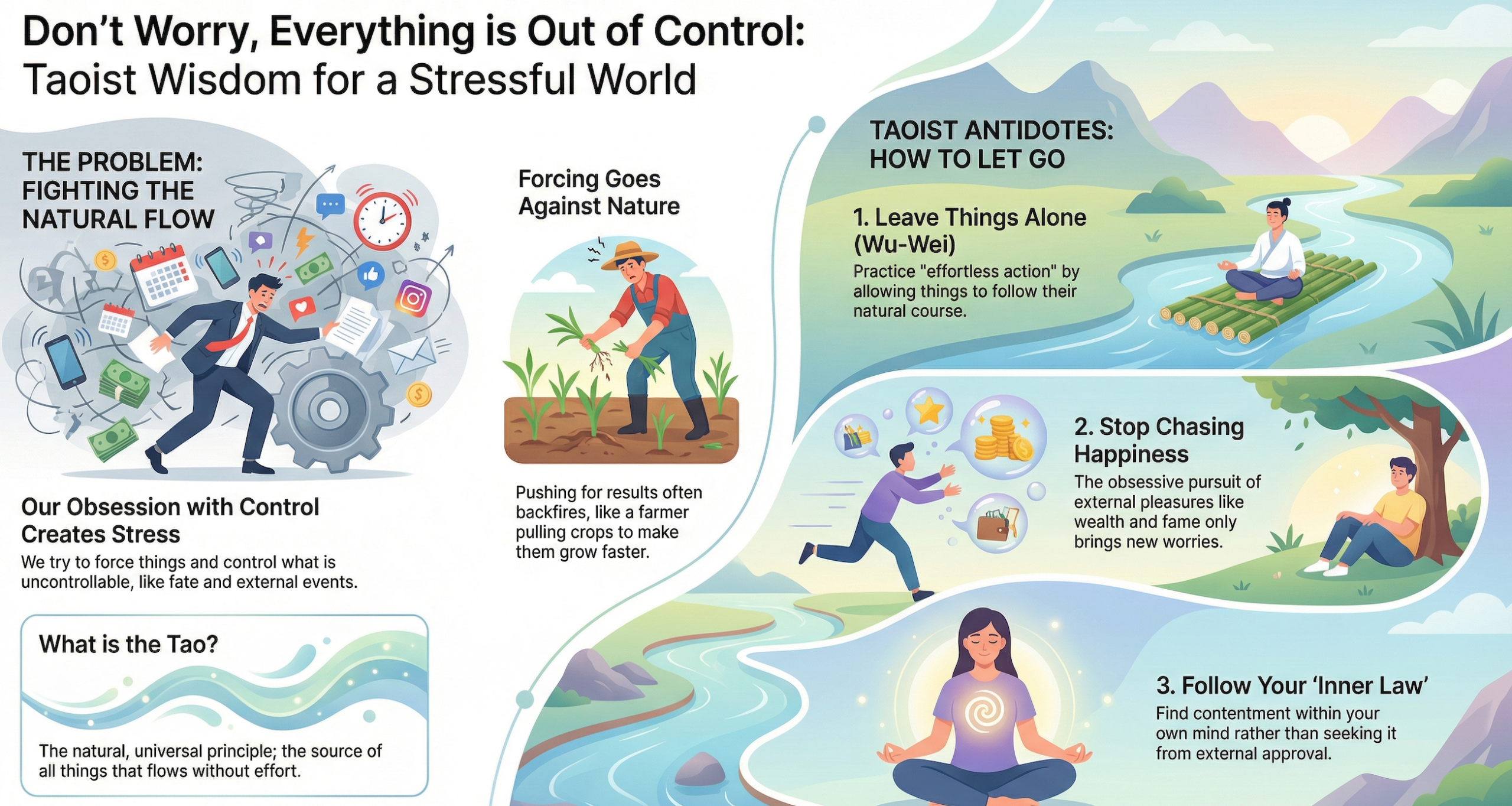
Our modern lives often feel like an unwinnable war against chaos. We are chronically stressed, perpetually exhausted, and relentlessly driven toward burnout. Faced with a world that feels increasingly out of our control, our instinct is to grip tighter, to double our efforts, to force our will upon circumstances. But what if this instinct is the very source of our suffering?
The ancient Taoist sages, like Lao Tzu and Zhuangzi, saw this struggle thousands of years ago. They offered a surprisingly effective and radically counter-intuitive alternative: letting go. This is not a philosophy of resignation, but of profound power. The following five lessons are potent antidotes to the anxieties of our insane, stressful world, offering a path not of forceful conquest, but of intelligent, effortless flow.
1. The Surprising Power of “Doing Nothing“
To the modern mind, obsessed with productivity and achievement, “doing nothing” is a cardinal sin. Yet for Taoists, the principle of wu-wei, or “effortless action,” is the key to effective living. This is not about laziness or passivity. It is the wisdom of ceasing to force things against their natural course.
From a Taoist viewpoint, our trouble begins the moment we try to force our way through life, attempting to alter nature or control things that are fundamentally beyond our influence. We become like the farmer who, in his impatience, pulls on his young crops to make them grow faster. His effort is not only wasted, but he ends up damaging the very thing he seeks to nurture. This is the low-grade panic of refreshing your inbox, the frantic energy of over-planning a vacation, the subtle violence of forcing a conversation that isn’t ready to happen. We damage the roots of our own joy.
The sage Lao Tzu saw this overextension as a fundamental weakness. When we try to force control or rush an outcome, we lose our foundation.
those who stand on tiptoes do not stand firmly, and those who rush ahead don’t get very far.
2. Why Chasing Happiness Is a Lose-Lose Situation
We are conditioned to believe that happiness is a prize to be won through relentless pursuit. We chase wealth, fame, power, and recognition, believing they are the keys to contentment. The Taoist sage Zhuangzi observed this frantic quest and saw not joy, but misery. He noted that the people most obsessed with obtaining happiness often had faces that looked “tired and grim.”
This pursuit, he argued, is a lose-lose situation. The chase itself exhausts us, and even if we succeed, the prize only brings new anxieties. When we attain wealth or fame, we do not find peace; we find a new, persistent fear of losing them. We become slaves to the very things we thought would set us free. Zhuangzi described this doomed state perfectly:
Those who think that wealth is the proper thing for them cannot give up their revenues; those who seek distinction cannot give up the thought of fame; those who cleave to power cannot give the handle of it to others. While they hold their grasp of those things, they are afraid (of losing them). When they let them go, they are grieved; and they will not look at a single example, from which they might perceive the (folly) of their restless pursuits: such men are under the doom of Heaven.
The paradox is that true contentment isn’t found; it’s uncovered. When we cease the frantic chase, the anxiety of winning or losing dissolves, creating the space for a peace that was present all along.
3. The Futility of Control: Finding Your “Inner Law”
Our modern world is obsessed with control. We try to manage every outcome, control every perception, and bend every circumstance to our will. Zhuangzi drew a sharp distinction between the person “whose law is within himself” and the one “whose law is outside himself.” The second person is a “plaything of his circumstances,” their mood swinging violently with every external event. When things go well, they are happy; when things go poorly, they are miserable, forever trapped in a futile struggle against a universe they cannot command.
This is the plight of the archer in Zhuangzi’s famous story. In practice, he shoots perfectly. But when a prize is at stake, his aim falters terribly. His skill has not changed, but his mind has. As Zhuangzi explained, “the need to win drains him of power.”
This internal obsession with controlling outcomes is mirrored by our external anxiety over events we can’t possibly influence. Zhuangzi shows us how we sabotage ourselves; his contemporary Liezi reveals how we exhaust ourselves worrying about the universe itself. The sage Liezi tells a story of a man who was consumed by the fear that the sky would fall and the earth would break apart, leaving him with no place to run. Liezi’s conclusion cuts to the heart of the matter with stark clarity:
It’s nonsense even to think about whether heaven and earth can or cannot be destroyed. Whether they will perish or not is something we don’t know. If heaven and earth will not perish, that’s great. We can live our lives without worry. However, if they will perish, that’s something we can’t do much about, so why worry about it?
The lesson is not one of nihilism, but of focus. The only domain we truly have dominion over is our own mind, our choices, and our attitude. This is our “inner law,” and cultivating it is the only path to unshakable peace.
4. Embrace Emptiness, Escape the Rat Race
The Taoist sages offer a profound liberation: what if the things we kill ourselves chasing—likes, promotions, praise—are not inherently valuable? What if their power over us is a story we tell ourselves, a story we can stop telling? The sage Liezi argued that we would be less stressed if we were “empty of all these attachments.”
He pointed out that we often seek credit for things that aren’t entirely our own doing. An Instagram model praised for their beauty owes much to genetics and prevailing cultural standards. The accomplishment is not entirely their own. From a Taoist perspective, praise—along with fame, wealth, and power—is fundamentally “empty.” These pursuits have no inherent value; we are the ones who attribute meaning to them.
This is not a cynical declaration that life is meaningless. It is the opposite. It reveals that value is not something out there to be captured, but something we generate. By recognizing the “emptiness”—the lack of inherent, fixed importance—of the rat race, we reclaim the power to find meaning in stillness, in being, rather than in ceaseless acquiring. This acceptance cultivates a profound peace of mind, allowing us to step off the treadmill of endless striving. As Liezi warned:
If you do not know how to keep still in this crazy world, you will be drawn into all kinds of unnecessary trouble.
5. The Final Step: You Must Let Go of Letting Go
Here we arrive at a more subtle and advanced Taoist insight, a concept known as “Chongxuan,” or “Double Mystery.” It addresses the ultimate paradox of spiritual striving: the moment “letting go” becomes another goal to achieve, it becomes just another form of attachment.
The path of the Double Mystery, as analyzed by the scholar Cheng Xuanying, involves two crucial steps. First, one must step back from the eternal tug-of-war between grasping for things (‘having’) and pushing them away (‘not having’). This is the initial, familiar act of letting go.
But then comes the second, more profound step. One must also let go of the attachment to this state of profound non-attachment itself. One must release the very tool of “letting go” once the job is done. This is the meaning of “Xuan zhi you Xuan,” or “Mystery upon Mystery.” The core of this wisdom is to achieve a state of:
not only not being attached to attachment, but also not being attached to non-attachment.
This is what makes the Taoist path so radical. It prevents the search for enlightenment from becoming another ego-driven contest. It is the final release that allows for a state of true, spontaneous, and effortless being. It is not about trying to let go; it is simply to be.
Conclusion: Flowing With the Way
These are not life hacks; they are a recalibration of the soul. The Taoist path asks us to trade the brittle strength of the clenched fist for the immense, unyielding power of the flowing river. It is a call to stop fighting the current of reality and instead learn to navigate it with grace, wisdom, and a quiet mind. True power is not found in the force of our grip, but in the profound courage of our release.
What is one thing you are trying to control today that you could, instead, simply allow to be?