By Ellen | Project observations and practical guide | Published October 23, 2026
A new publishing site went live on 1 June 2025 with no organic-search history to inherit.
For weeks, its Google Search Console graph barely moved. That is the moment when many teams panic, add more keywords, publish thinner pages, and call it “scale.”
Later in the displayed period, clicks and impressions rose sharply. The graph shows a change in search performance; it does not, by itself, explain what caused that change.
My work on the project treated search as a system: a way to match a real question with a useful page, a clear answer, a discoverable route and a next decision. This article explains that operating approach, not a formula for reproducing the curve.
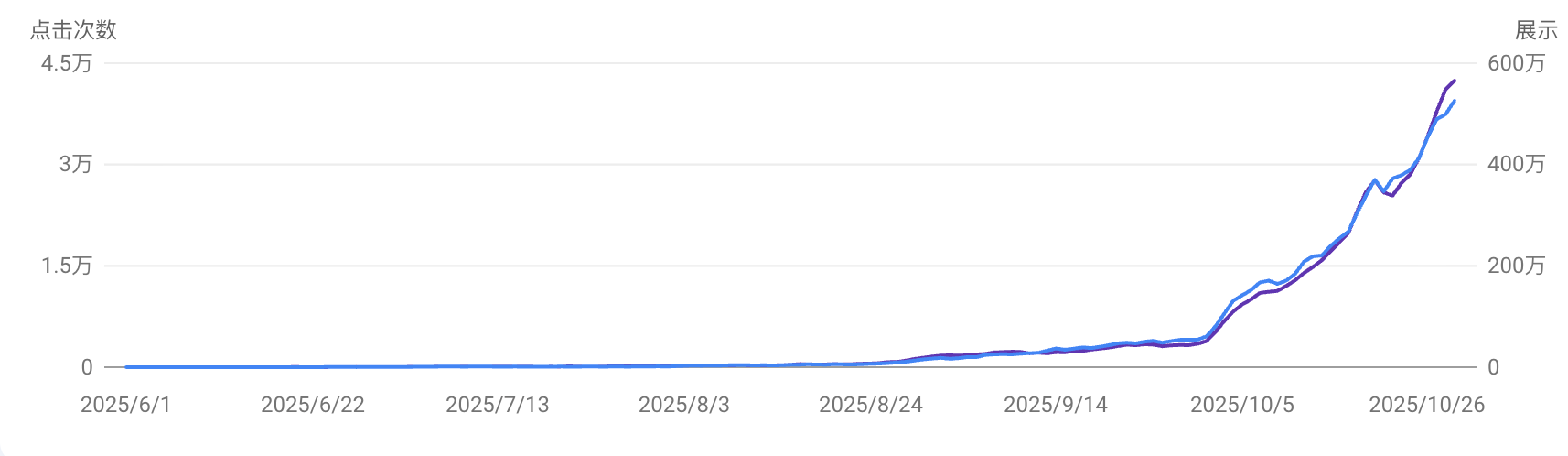
I led the long-tail intent architecture behind that project. The project context and my role are first-person accounts; the screenshots provide limited supporting observations, not an independent audit of the work.
For readers of the English article, the chart labels mean clicks (left) and impressions (right); the Chinese unit 万 means 10,000. Axis limits are not measured endpoint values. The supplied crops do not include the full report settings or an underlying data export, so I do not use them here to state exact daily totals. Google explains these metrics and report settings in its Search Console guidance.
The technical design could support large-scale publishing. That alone was not the advantage. Large-scale publishing can create a large-scale mess if every page says almost the same thing.
The planning priority was deciding which questions earned a page, what the page had to answer, and what a reader should do after reading it. Those are choices a team can inspect and improve, even when the reasons for a traffic change remain uncertain.
The conflict: publishing more pages can make a site less useful
A page count is easy to report.
It does not tell you whether a technical buyer found the fit condition they needed, whether an editor found a source worth citing, or whether a customer could move from research to a meaningful next step.
I have seen teams publish hundreds of pages because a keyword tool made the list look promising. The pages appeared in a spreadsheet, but not in a buyer’s decision process.
That is the wrong unit of work.
The useful unit is a decision path: a real person has a question, finds the relevant page, sees what is supported, understands the limits and knows what to do next.
Give every page a job before you create it
The new-site project started with long-tail queries. We did not treat those queries as strings to place in titles.
We treated them as evidence of a person trying to complete a task.
A detailed query can reveal whether someone is comparing options, diagnosing a problem, checking compatibility, looking for an example, or trying to decide what to buy or do next.
For each page cluster, use this working sheet before drafting:
- The exact question: What is the reader trying to decide or complete?
- The reader: Who is asking it, and what do they already know?
- The answer: What can we state directly and support?
- The fit condition: When is this answer useful, and when is it not?
- The evidence: What source, example, product detail or expert input supports it?
- The next move: What page, product, document or conversation should follow?
This changes the production conversation.
Instead of asking, “How many pages can we publish this month?” the team asks, “Which unanswered questions block discovery or a useful decision?”
A practical way to build the map
Take one offer or one topic area.
Collect the search queries, sales questions, support questions, comparison points and recurring misunderstandings that surround it. Remove duplicates, then group the questions by the decision they support.
A technical evaluator may need compatibility and implementation detail. A budget holder may need scope, constraints and the difference between options. A user may need a clear sequence of steps.
Give each group a page type. Some deserve a service page. Some deserve an application page, FAQ, comparison, guide or evidence note. Some do not deserve a page at all.
That restraint matters. An unanswered question is not automatically a page opportunity. It needs a clear audience, a supportable answer and a place in the wider information structure.
Build templates that protect quality at scale
Programmatic SEO is often described as a template problem.
In practice, it is a quality-control problem.
A template can create thousands of URLs quickly. It can also repeat the same vague claim, hide missing evidence and send readers into dead ends. Scale is not a substitute for distinct value.
For the new-site project, the page system needed to keep the answer specific enough for a long-tail question while preserving a consistent information model across many pages.
Use a page specification that forces the key decisions into the open:
- Page purpose
- Primary reader and decision
- Direct answer above the fold
- Required source or subject-matter input
- Useful detail that changes by page
- Fit conditions and exclusions
- Related pages and internal-link destinations
- Next step
- Review owner and review date
Then review a small but difficult sample before publishing at scale.
Choose queries that look similar but require different answers. Check whether the page would still be useful if its keyword were removed. Check whether the answer depends on a source you do not have permission to use.
If the page only works because a phrase appears many times, it is not ready.
Give search systems a route, not a pile of URLs
A useful page still needs to be reachable.
The architecture on a large site has to make related questions, related pages and page importance legible to both readers and crawlers.
This does not mean forcing every page into a huge category tree. It means building deliberate paths from broad subjects to more specific decisions, then linking back to the pages that provide context or a next move.
A practical technical review for each priority page includes:
- A preferred canonical URL
- A crawlable HTML answer, not only a scripted interface
- A descriptive title and heading
- A sitemap entry for the canonical page you want indexed, where appropriate
- At least one relevant internal link into the page
- Useful links out to the evidence, related decision page or next step
- A record of who updates the page when its source changes
Do not confuse this with a ranking guarantee.
It is a way to make intended public information available for discovery and review. Search systems still decide what to crawl, index and show. Google recommends crawlable links; a sitemap helps discovery but does not guarantee crawling or indexing.
The turning point: traffic alone is not a commercial outcome
The graph in Figure 1 is satisfying to look at.
It can also distract a team from the harder question: did the page help someone make progress, or did it merely attract a click?
A separate ecommerce project brought that question into the content-planning process.
The work began in July 2024 because standard product pages were not meeting enough informational needs. Buyers wanted to understand a product in a real situation before moving to a purchase decision.
The content system used AI-assisted research and drafting, with human review for accuracy, brand fit and commercial relevance. Pages were built around use scenarios, product decision factors and direct product paths.
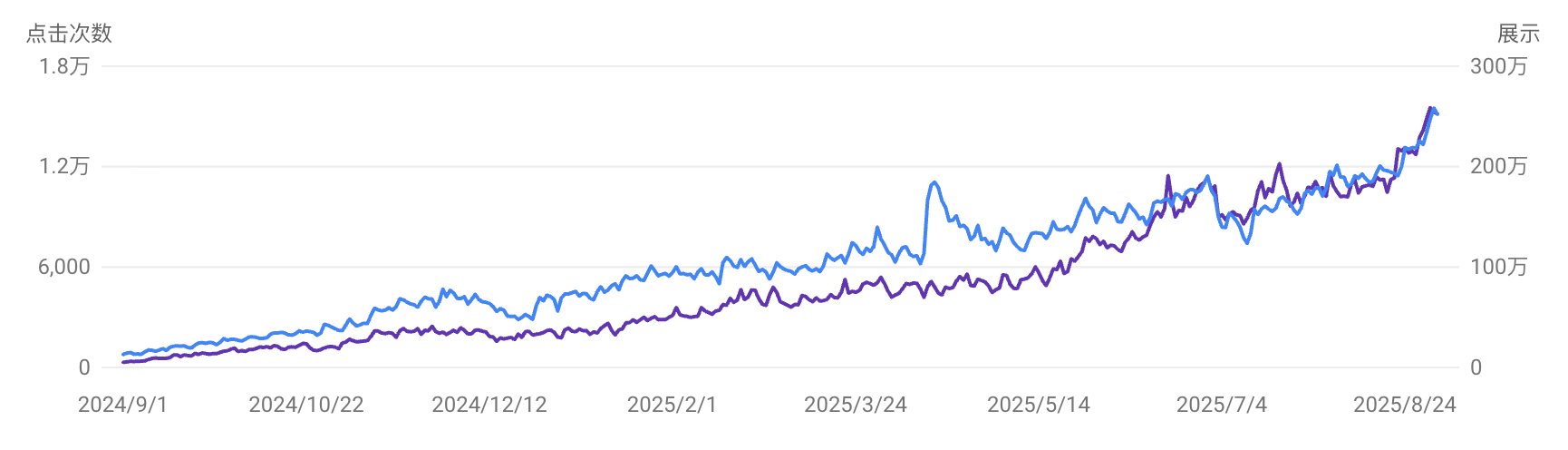
The lesson was not “add AI content to a product catalogue.”
The lesson was that an informational page can still be commercial when it helps a buyer evaluate a real situation and offers an appropriate route to the relevant product or action.
One client team had been thinking in a familiar split: content was for traffic, product pages were for conversion.
The work challenged that split. The content page had to explain the scenario clearly enough for a reader to judge fit, then make the next product decision easy to take.
The internal conversion reporting for that project is not published here. It should not be turned into a public benchmark without a defined metric, date range and approved data source.
The design principle is public and repeatable: research content should not abandon the reader at the moment they are ready to decide.
Use AI to increase coverage, not to remove responsibility
In my experience on these projects, AI was useful in both systems.
It helped surface patterns, organise input, draft variants and make large-scale operations more practical. It did not become the source of truth.
Every high-stakes page needs a human answer to a few basic questions:
- Is the claim accurate within its stated scope?
- Can we identify the source or subject-matter owner?
- Does the wording make a promise the business cannot keep?
- Does this page answer the question it targets?
- Is the next step appropriate for the reader’s stage of decision?
A fluent paragraph is not evidence. Google also cautions that generating many pages without adding user value may violate its scaled content abuse policy. Human review needs to test accuracy and usefulness, not simply approve fluent wording.
A complete-looking page is not necessarily a useful one. AI makes it easier to generate language; it does not remove the need to judge scope, proof, fit and responsibility.
What a B2B team can borrow without copying the scale
A B2B team does not need to copy the scale of a large publishing operation.
They often need ten pages that answer the questions currently trapped in sales calls, PDFs, personal inboxes and the heads of subject-matter experts.
Start with one buyer journey. Pick the point where a serious prospect gets stuck before an enquiry, a technical review, an internal handover or a proposal.
Build one decision page around that point. Include the audience, the direct answer, relevant proof, fit conditions, a responsible owner and a next step.
Then connect it to the service page, the evidence page and the practical contact route. Keep a record of what was changed and which questions remain open.
That is already a visibility system.
A seven-day start for a real website
Use this as a suggested working sequence, not a delivery or performance promise. Move more slowly where permissions, evidence or technical access need attention.
Day 1 — Choose one offer and one decision
Write down one offer you want a visitor to understand. Name the decision a buyer needs to make before they contact you.
Day 2 — Collect the questions already in your business
Review sales calls, proposals, support conversations and product documentation that you are allowed to use. Capture the questions in plain language.
Day 3 — Separate facts from attractive wording
Record whether each important statement is client-confirmed, source-supported or pending verification. Separately mark interpretations and hypotheses; approval does not turn either into a verified fact. Ask the person responsible to confirm claims that affect scope, availability or outcomes, and identify the evidence behind them.
Day 4 — Draft one decision page
Write the opening around the reader, their question and one important fit condition. Add only the evidence you can identify and use.
Day 5 — Build the route
Link the page from the relevant service or product page. Add links to the evidence and the next action a reader can take.
Day 6 — Review it with someone who did not write it
Ask a colleague or a customer-facing teammate to explain the offer back to you. Record what they cannot explain, rather than defending the draft.
Day 7 — Publish the useful version and set a review date
Publish only the statements you can stand behind. Record the source, owner, change date and the question you still need to answer.
Search growth does not begin when a dashboard turns upward.
It begins when a business stops manufacturing pages for a number and starts making its real expertise easier to inspect, understand and act on.
That work can be small at the start. One honest page can become a stronger foundation than one hundred pages written without a decision, a source or a next step.
Evidence and disclosure
These are anonymized historical project observations supplied by Ellen. Project dates, responsibilities and workflow descriptions are first-person accounts. The screenshots show clicks and impressions in the visible chart areas, but not the full property configuration, filters, reporting interval or underlying export. They are not independently audited case studies.
The lines continue beyond the final labeled date ticks, so those labels should not be read as exact report end dates. I have omitted precise daily endpoint claims rather than infer them from the crops. The charts do not show sessions, unique users, conversions, revenue, total-site traffic or a causal experiment.
The projects differ in context and observation period; they are not a controlled comparison. Demand, seasonality, other site changes and search-system changes may also affect performance. This material cannot isolate how much growth came from any one activity, including AI assistance.
The examples illustrate an operating approach: intent-led page planning, scalable information architecture, AI-assisted production with human review, and clearer paths from research to an appropriate business decision. They do not guarantee indexing, rankings, AI citations, traffic, conversions or commercial outcomes.
Client identities and property identifiers are not shown. The supplied chart images are reproduced without redrawing the data. Google documentation linked above explains general practices and metrics; it does not validate these project accounts or endorse WuWei Logic.
Put the method to work
Use the Visibility Systems Field Guide to review a priority page, or examine the clearly labeled illustrative working examples.
If your team needs help connecting expertise, evidence and buyer questions, explore Visibility Systems or discuss a Foundation Sprint. Work begins with an agreed scope, not a traffic promise.