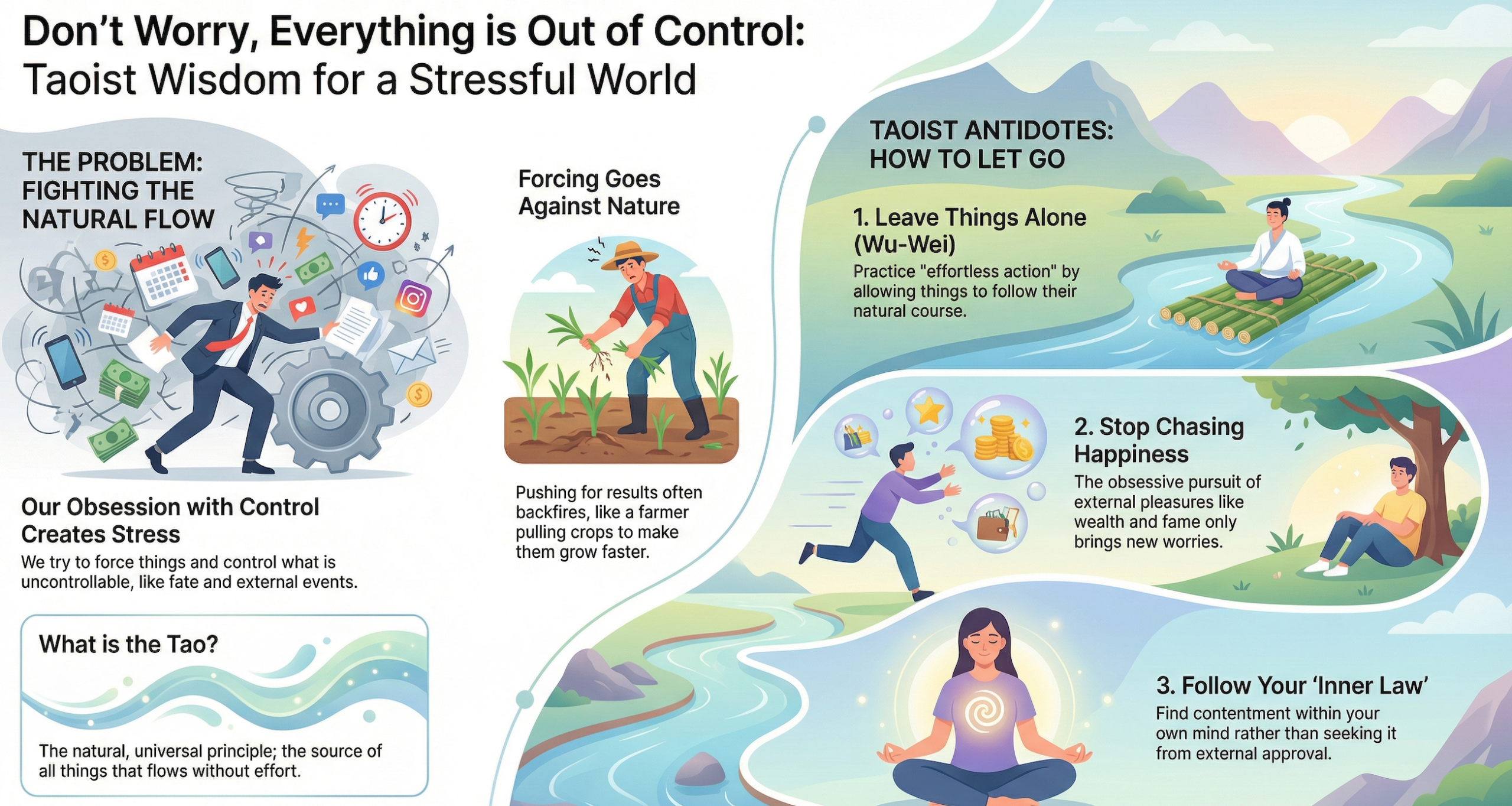
Our modern lives often feel like an unwinnable war against chaos. We are chronically stressed, perpetually exhausted, and relentlessly driven toward burnout. Faced with a world that feels increasingly out of our control, our instinct is to grip tighter, to double our efforts, to force our will upon circumstances. But what if this instinct is the very source of our suffering?
The ancient Taoist sages, like Lao Tzu and Zhuangzi, saw this struggle thousands of years ago. They offered a surprisingly effective and radically counter-intuitive alternative: letting go. This is not a philosophy of resignation, but of profound power. The following five lessons are potent antidotes to the anxieties of our insane, stressful world, offering a path not of forceful conquest, but of intelligent, effortless flow.
1. The Surprising Power of “Doing Nothing“
To the modern mind, obsessed with productivity and achievement, “doing nothing” is a cardinal sin. Yet for Taoists, the principle of wu-wei, or “effortless action,” is the key to effective living. This is not about laziness or passivity. It is the wisdom of ceasing to force things against their natural course.
From a Taoist viewpoint, our trouble begins the moment we try to force our way through life, attempting to alter nature or control things that are fundamentally beyond our influence. We become like the farmer who, in his impatience, pulls on his young crops to make them grow faster. His effort is not only wasted, but he ends up damaging the very thing he seeks to nurture. This is the low-grade panic of refreshing your inbox, the frantic energy of over-planning a vacation, the subtle violence of forcing a conversation that isn’t ready to happen. We damage the roots of our own joy.
The sage Lao Tzu saw this overextension as a fundamental weakness. When we try to force control or rush an outcome, we lose our foundation.
those who stand on tiptoes do not stand firmly, and those who rush ahead don’t get very far.
2. Why Chasing Happiness Is a Lose-Lose Situation
We are conditioned to believe that happiness is a prize to be won through relentless pursuit. We chase wealth, fame, power, and recognition, believing they are the keys to contentment. The Taoist sage Zhuangzi observed this frantic quest and saw not joy, but misery. He noted that the people most obsessed with obtaining happiness often had faces that looked “tired and grim.”
This pursuit, he argued, is a lose-lose situation. The chase itself exhausts us, and even if we succeed, the prize only brings new anxieties. When we attain wealth or fame, we do not find peace; we find a new, persistent fear of losing them. We become slaves to the very things we thought would set us free. Zhuangzi described this doomed state perfectly:
Those who think that wealth is the proper thing for them cannot give up their revenues; those who seek distinction cannot give up the thought of fame; those who cleave to power cannot give the handle of it to others. While they hold their grasp of those things, they are afraid (of losing them). When they let them go, they are grieved; and they will not look at a single example, from which they might perceive the (folly) of their restless pursuits: such men are under the doom of Heaven.
The paradox is that true contentment isn’t found; it’s uncovered. When we cease the frantic chase, the anxiety of winning or losing dissolves, creating the space for a peace that was present all along.
3. The Futility of Control: Finding Your “Inner Law”
Our modern world is obsessed with control. We try to manage every outcome, control every perception, and bend every circumstance to our will. Zhuangzi drew a sharp distinction between the person “whose law is within himself” and the one “whose law is outside himself.” The second person is a “plaything of his circumstances,” their mood swinging violently with every external event. When things go well, they are happy; when things go poorly, they are miserable, forever trapped in a futile struggle against a universe they cannot command.
This is the plight of the archer in Zhuangzi’s famous story. In practice, he shoots perfectly. But when a prize is at stake, his aim falters terribly. His skill has not changed, but his mind has. As Zhuangzi explained, “the need to win drains him of power.”
This internal obsession with controlling outcomes is mirrored by our external anxiety over events we can’t possibly influence. Zhuangzi shows us how we sabotage ourselves; his contemporary Liezi reveals how we exhaust ourselves worrying about the universe itself. The sage Liezi tells a story of a man who was consumed by the fear that the sky would fall and the earth would break apart, leaving him with no place to run. Liezi’s conclusion cuts to the heart of the matter with stark clarity:
It’s nonsense even to think about whether heaven and earth can or cannot be destroyed. Whether they will perish or not is something we don’t know. If heaven and earth will not perish, that’s great. We can live our lives without worry. However, if they will perish, that’s something we can’t do much about, so why worry about it?
The lesson is not one of nihilism, but of focus. The only domain we truly have dominion over is our own mind, our choices, and our attitude. This is our “inner law,” and cultivating it is the only path to unshakable peace.
4. Embrace Emptiness, Escape the Rat Race
The Taoist sages offer a profound liberation: what if the things we kill ourselves chasing—likes, promotions, praise—are not inherently valuable? What if their power over us is a story we tell ourselves, a story we can stop telling? The sage Liezi argued that we would be less stressed if we were “empty of all these attachments.”
He pointed out that we often seek credit for things that aren’t entirely our own doing. An Instagram model praised for their beauty owes much to genetics and prevailing cultural standards. The accomplishment is not entirely their own. From a Taoist perspective, praise—along with fame, wealth, and power—is fundamentally “empty.” These pursuits have no inherent value; we are the ones who attribute meaning to them.
This is not a cynical declaration that life is meaningless. It is the opposite. It reveals that value is not something out there to be captured, but something we generate. By recognizing the “emptiness”—the lack of inherent, fixed importance—of the rat race, we reclaim the power to find meaning in stillness, in being, rather than in ceaseless acquiring. This acceptance cultivates a profound peace of mind, allowing us to step off the treadmill of endless striving. As Liezi warned:
If you do not know how to keep still in this crazy world, you will be drawn into all kinds of unnecessary trouble.
5. The Final Step: You Must Let Go of Letting Go
Here we arrive at a more subtle and advanced Taoist insight, a concept known as “Chongxuan,” or “Double Mystery.” It addresses the ultimate paradox of spiritual striving: the moment “letting go” becomes another goal to achieve, it becomes just another form of attachment.
The path of the Double Mystery, as analyzed by the scholar Cheng Xuanying, involves two crucial steps. First, one must step back from the eternal tug-of-war between grasping for things (‘having’) and pushing them away (‘not having’). This is the initial, familiar act of letting go.
But then comes the second, more profound step. One must also let go of the attachment to this state of profound non-attachment itself. One must release the very tool of “letting go” once the job is done. This is the meaning of “Xuan zhi you Xuan,” or “Mystery upon Mystery.” The core of this wisdom is to achieve a state of:
not only not being attached to attachment, but also not being attached to non-attachment.
This is what makes the Taoist path so radical. It prevents the search for enlightenment from becoming another ego-driven contest. It is the final release that allows for a state of true, spontaneous, and effortless being. It is not about trying to let go; it is simply to be.
Conclusion: Flowing With the Way
These are not life hacks; they are a recalibration of the soul. The Taoist path asks us to trade the brittle strength of the clenched fist for the immense, unyielding power of the flowing river. It is a call to stop fighting the current of reality and instead learn to navigate it with grace, wisdom, and a quiet mind. True power is not found in the force of our grip, but in the profound courage of our release.
What is one thing you are trying to control today that you could, instead, simply allow to be?
发表回复